
Coffee roasting is a precisely orchestrated sequence of chemical and physical transformations that unfold as beans respond to carefully applied heat. Understanding and controlling the temperature profile is essential to guiding beans through their journey from raw to aromatic perfection.
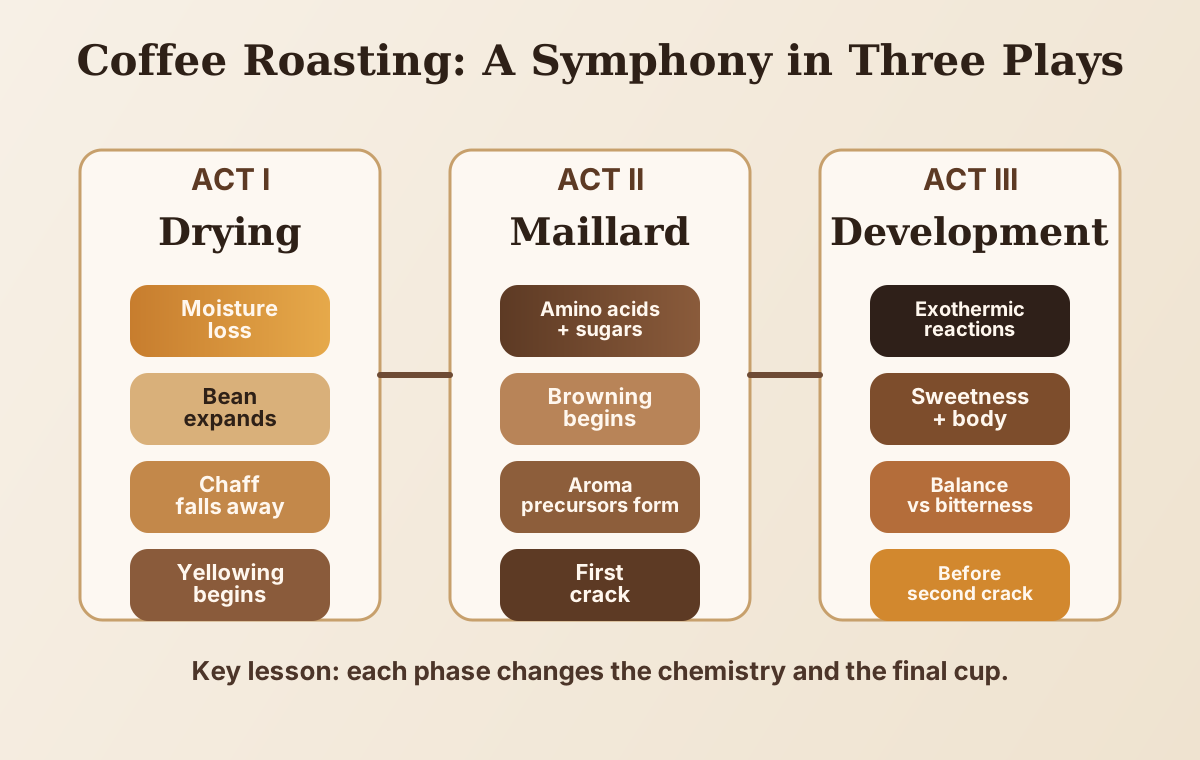
The process is often simplified into three phases: drying, Maillard, and development. While this description is useful, it is not always interpreted the same way across the literature, and that is exactly why it matters to think of roasting as a controlled system rather than a fixed recipe.
Act I: The drying phase
As the name suggests, the first task is to get rid of the intrinsic moisture by evaporating it with heat. In the initial drying phase, beans absorb substantial thermal energy from the roasting environment without a corresponding rise in their own temperature. This endothermic behaviour persists until bean moisture falls below roughly 5%.
Scientific work has shown that green coffee beans require around 750–800 J/g of energy input before exothermic reactions begin. That energy is largely spent driving water evaporation and initiating preliminary structural changes in carbohydrates and proteins. Bean temperature typically plateaus around 100–105°C until sufficient moisture has been removed.
Green coffee beans contain about 8–13% moisture by weight. The evaporation rate rises with temperature, peaking around 200°C, and then slows as the bean dries further. This water loss creates vapor pressure within bean cells and leads to expansion, which is why beans begin to inflate and expand like tiny balloons. During this phase the release is mostly water vapor and a small amount of CO₂, with only minimal volatile aromatic compounds being produced.
Microscopic studies show that the drying phase initiates important structural changes. The cellulose-hemicellulose matrix begins to soften above 50°C, and pore structure becomes more open as temperatures rise toward 120–130°C. This matters because later reactions rely on this newly opened structure. If the drying phase is too rapid or poorly controlled, the cell structure can rupture in a way that leads to baked or grassy defects. This is a useful reminder that the first act matters even if it is not where the most dramatic flavour chemistry happens.
Coffee bean moisture exists in two main states: free water and bound water. Free water sits in intercellular spaces and larger capillaries, while bound water is more tightly associated with carbohydrates, proteins, and cell walls. Removing bound water requires more energy and can continue into the early Maillard stage. Incomplete removal of bound water can inhibit later reactions, while excessive removal can accelerate pyrolysis later in the roast. In other words, the drying phase sets the stage for everything that follows.
This phase is not about elaborate flavour creation. It is about preparation. It establishes the physical and thermal conditions for all later development. The beans begin to expand, the chaff flakes off, and the yellowing of the bean signals the transition from drying into the next act.
Act II: The Maillard phase
The Maillard reaction, also known as the browning phase, is a complex chemical reaction between amino acids and reducing sugars when the bean is exposed to heat. This is where the potential for flavour begins to take shape. It is not the final expression of taste yet, but it lays down the structure of what the development phase can later realize.
The reaction begins when reducing sugars, especially glucose, fructose, and sucrose, interact with free amino acids, peptides, and proteins. After drying, when bean temperature reaches roughly 150–170°C, the stages of non-enzymatic browning begin. This creates a vast family of intermediate compounds called Amadori products, which then fragment and further transform into melanoidins and heterocyclic compounds that influence both color and flavor.
The chemistry is highly specific. Different amino acids contribute to different flavor families. For example, cysteine can contribute to roasted and savory notes, while leucine can contribute to malt and chocolate-like impressions. The most reactive amino acids in coffee include asparagine, glutamine, phenylalanine, and methionine, and their concentrations vary by bean variety and origin. This means that even the same roast profile can lead to different sensory outcomes depending on the green coffee itself.
During the Maillard phase, the reaction produces hundreds of volatile compounds, including pyrazines, furans, thiols, and aldehydes. These compounds are key to coffee’s nutty, caramel-like, earthy, fruity, and malty character. The precise ratio of these compounds changes with temperature and time. Faster temperature increases can help create bitterness and phenolic notes, while moderate increases tend to favor the more desirable sweet and aromatic compounds.
This is also why the time-temperature relationship matters so much. The rate of Maillard reactions roughly doubles with each 10°C rise in temperature, but the compounds formed vary depending on how that heat is applied. A controlled rise through the Maillard phase can favor desirable pyrazines and furans; a rapid rise may push the roast toward bitterness and imbalance. This is the point where the roast really starts to define character.
The first audible crack marks the end of the browning phase and the beginning of the final act.
Act III: The development phase
The development phase is the culmination of roasting, where thermal management decides whether the roast becomes delicate, sweet, expressive, and balanced or flat, hollow, and bitter. This stage is marked by the transition from endothermic to exothermic reactions, with bean temperatures often ranging from 190 to 220°C.
In this phase, the bean releases stored thermal energy through complex chemical decompositions. Because of internal reactions and the continued breakdown of sugars, proteins, and other compounds, the roast can accelerate quickly. The first crack occurs at roughly 196–204°C, caused by rapid vapor pressure buildup and the structural rupture of cellular walls. The second crack follows later, at around 224–230°C, and represents a deeper stage of breakdown.
The development phase is a careful balancing act between caramelization and pyrolysis. Caramelization involves sugar decomposition and creates compounds associated with sweetness and depth. Pyrolysis, meanwhile, involves thermal breakdown without oxygen and can generate phenols, carbonyls, and other more intense, darker compounds. The right balance determines complexity and sweetness. Too much pyrolysis and the cup becomes smoky, bitter, and dull. Too little and the cup remains underdeveloped and grassy.
Time and temperature continue to shape the flavor profile in a non-linear way. Studies show that extending development time by 30–45 seconds may increase key flavor compounds significantly, but not equally across all chemical families. Pyrazines may peak early, while melanoidins and body-building compounds continue to evolve longer. Hence the development phase is not simply a matter of roasting longer; it is about managing the balance between sweetness, body, clarity, and bitterness.
In the world of specialty coffee, the goal is usually to stop the roast before the second crack, where the balance of sweetness, acidity, and bitterness is most expressive. Beyond that point, the roast often becomes too dark and the cup loses the nuanced complexity that makes coffee interesting.
Roasting is not just the application of heat. It is the management of chemical timing.
Why this matters
The real lesson is that coffee roasting is not a single moment or one magical phase. It is a sequence of changing conditions, each with its own chemistry and each with its own consequences for the cup. The drying phase prepares the bean, the Maillard phase builds aromatics and structure, and the development phase decides the final balance of sweetness, acidity, body, and clarity.
That is why a good roaster thinks in terms of profiles and control rather than arbitrary timing alone. The roast is a story told in temperature, time, and transformation. When you understand those three acts, you begin to see not just how coffee is roasted, but why it tastes the way it does.
Key takeaways
- The drying phase removes moisture and prepares the bean for later reactions.
- The Maillard phase builds the flavor precursors that define sweetness, body, and aroma.
- The development phase determines the final balance between clarity, complexity, and bitterness.
- Roasting is a controlled sequence of heat, time, and chemistry, not just a simple temperature setting.
- Understanding these stages gives roasters a better way to shape cup quality intentionally.